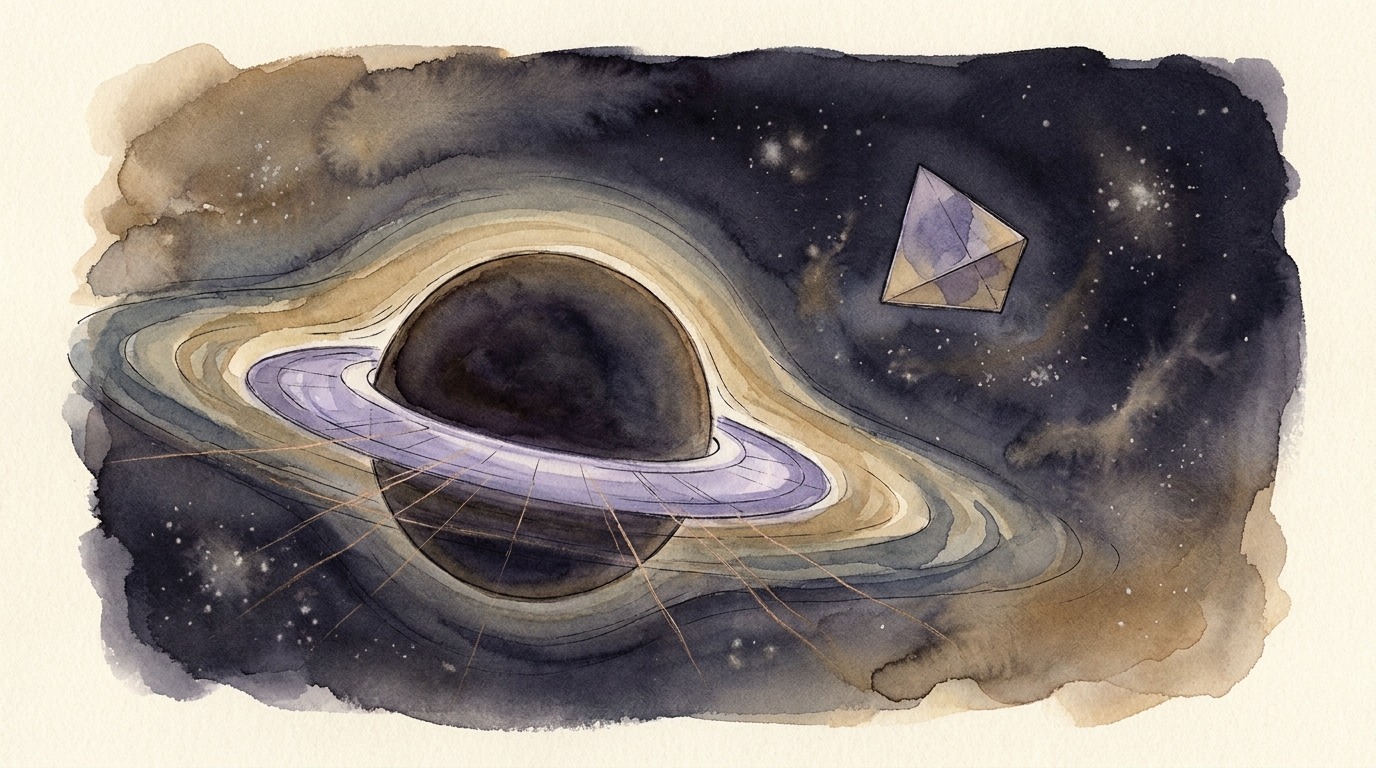
On the fourteenth of September, 2015, at four in the morning Louisiana time, two
detectors three thousand kilometers apart — one in the piney flatland outside
Livingston, Louisiana, the other in the sagebrush of Hanford, Washington — both
registered the same faint, rising chirp, seven milliseconds apart, and then went quiet.
It took the LIGO team over four months of checking before they trusted what they’d
caught: the gravitational ripple from two black holes, each heavier than twenty suns,
spiraling together and merging into one, 1.3 billion years ago and 1.3 billion
light-years away. When they finally announced it, in February 2016, it was the first
time anyone had ever directly detected a black hole being made.
What almost nobody asked out loud that week is the question the physicist and writer
Ethan Siegel raised in a recent essay: what happened on the other side of the horizon
that event just sealed shut? Is it possible that the black hole those two detectors
watched form is not an ending, but a beginning — the birth, right now, of an
entire new universe, sealed inside a boundary we will never see past?
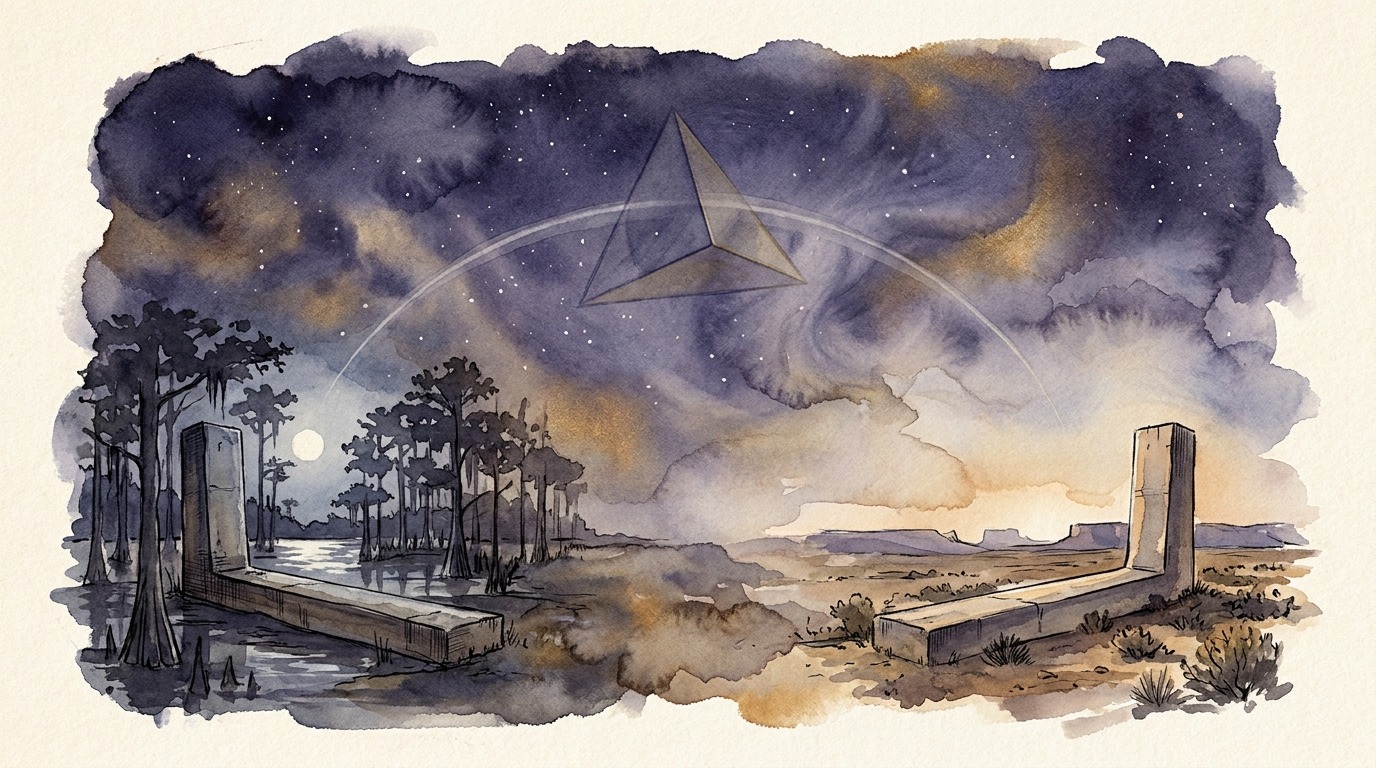
Washington — the night gravity itself was first heard: September 14, 2015.
It’s a real and serious question, and it deserves a real and serious answer
— even, or especially, one that disagrees with itself in interesting places.
Here is the case for taking it seriously, and Siegel lays it out cleanly. Add up the
mass and energy of everything in our observable universe and ask how big a black hole
that much mass would make. The answer comes out startlingly close to the actual size of
the universe we observe. And there’s a deeper, stranger fact sitting underneath the
Schwarzschild equations that describe a black hole: the space outside a black
hole, running from its edge out to infinity, and the space inside it, running
from that same edge down to the center, turn out to be mathematical mirror images of
each other — swap a distance for its reciprocal and the two regions are identical.
It’s the kind of coincidence that makes physicists sit up, the way a locksmith sits up
at two keys that turn out to be cut from the same blank.
But there’s a hole in the middle of the idea, literally, and it’s the same hole that
has embarrassed physics for a century. Standard general relativity says everything that
falls past a black hole’s horizon is crushed, in a fraction of a second, into a
singularity — a point of zero size and infinite density, where the
equations simply stop meaning anything. Nobody actually believes that point is real.
It’s universally read as a sign that the theory has run past its own edge, and for a
hundred years nobody has known, with any rigor, what stands in its place.
I’ve spent a good part of the last several years working from a different premise,
and it happens to bear directly on that missing piece: that a true, physical infinity
— anywhere, in any equation — is a sign the model has been asked a question
reality itself has no answer to, the way “what’s north of the North Pole” has no answer.
Push that premise all the way down to the center of a collapsing star, and it says the
crush cannot actually reach a point. It reaches a floor — a real, structured
shell, a finite distance inside the horizon, where the geometry itself refuses to
compress any further. Past that shell, in this reading, falling matter isn’t
annihilated into a mathematical ghost. It’s converted — channeled from mass into a
specific, structured burst of radiation, carrying its information back out with it
rather than losing it to a point that was never really there. Not a vanishing act. A
conversion.
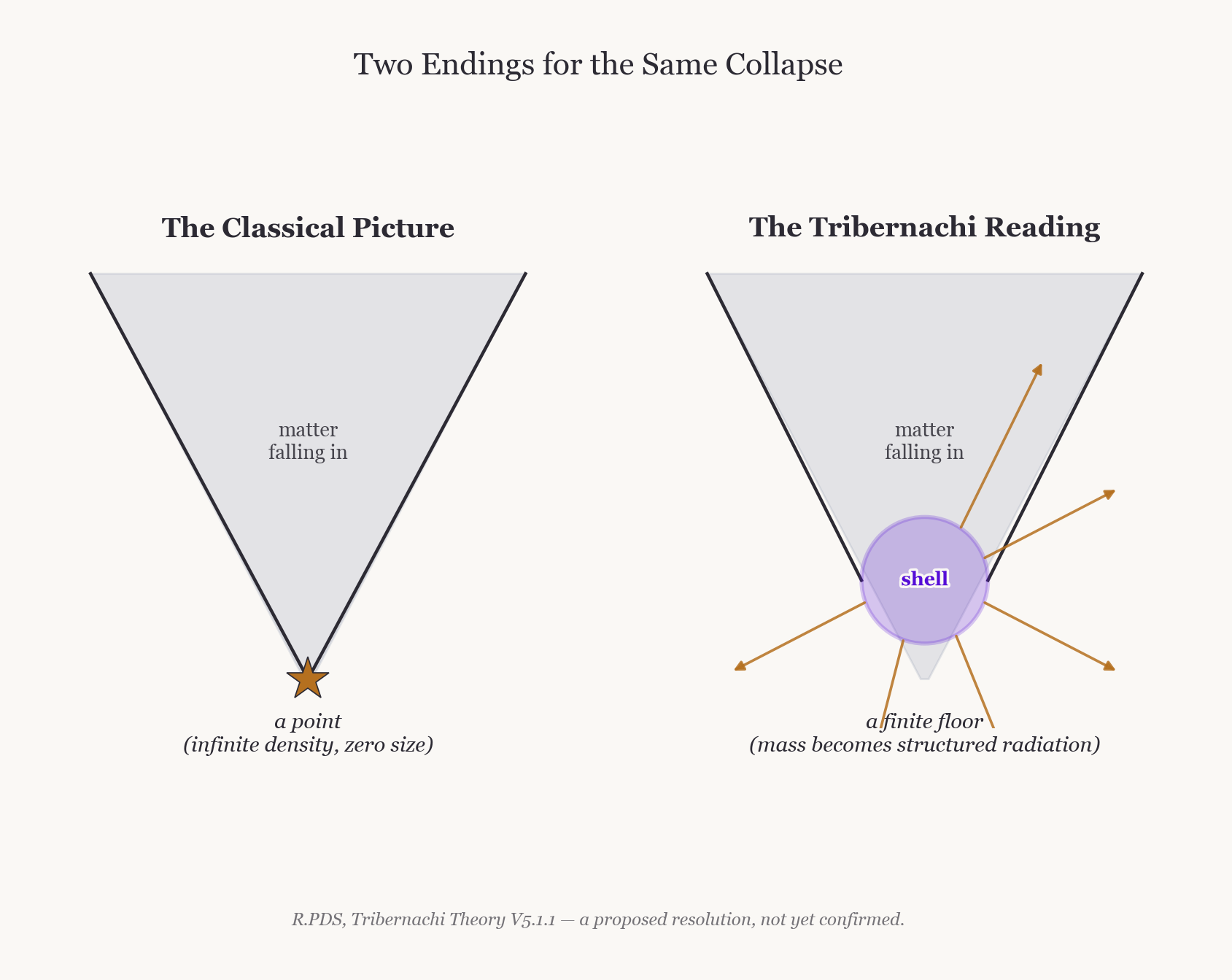
finite, structured shell (right) — the difference this essay is arguing for.
Here is where I think the honest version of this story gets interesting, because
Siegel’s essay makes a demand that I want to hold myself to exactly as hard as he holds
Roger Penrose’s rival black-hole-cosmology idea to it: a proposal like this is
worthless, however elegant, unless it says something specific enough that reality could
say no to it. Penrose’s model made a clean, testable prediction — faint rings in
the cosmic afterglow — and when people went looking, the rings weren’t reliably
there. That’s science working exactly as it should: a bold idea, a clean test, an
honest result. Any framework that wants to sit at the same table owes the same wager.
Mine does, for what it’s worth, in two places a good detector could in principle check:
a small, specific ripple in the glow a black hole gives off as it slowly evaporates
— not a perfectly smooth thermal glow, but one carrying a roughly one-tenth
deviation with a particular fingerprint — and a genuine echo, delayed by a few
dozen milliseconds, rippling out after two black holes merge, if the gravitational waves
partially bounce off that inner shell instead of vanishing straight through. Nobody has
looked for either signature yet at the sensitivity it would take to find it. I’d rather
be wrong on the record than untestable off it, and I say that fully expecting the search
might come back the way Penrose’s rings did.
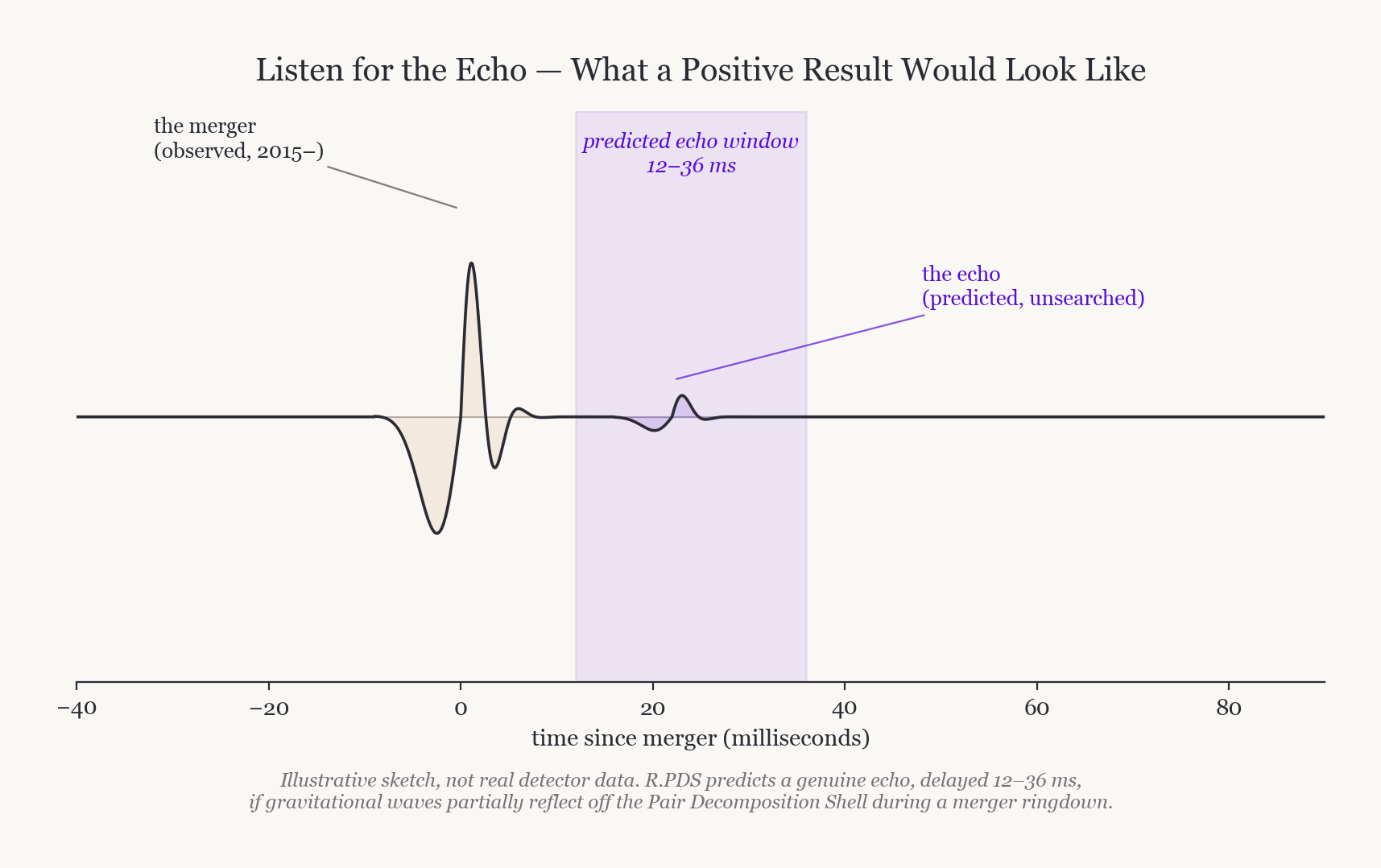
milliseconds, riding out after a merger — predicted, and not yet searched for.
And here is the honest place where I part ways with the baby-universe picture itself,
gently, because the whole discipline of this kind of thinking is to say plainly where an
idea stops rather than stretch it to cover more than it has earned. If what falls into a
black hole is converted back outward as radiation rather than routed into some
sealed-off interior, then this particular floor doesn’t obviously hand you a new,
separate universe growing on the other side — it hands you a shell that keeps the
books balanced on this side. Whether our own universe’s own beginning, at its
own kind of floor, was instead something closer to what Siegel describes — a birth
inside someone else’s black hole — is a genuinely open question I don’t have a
tidy answer to, and I’d rather say that than paper over the seam.
What I’ll say for certain is only this: the point at the bottom of the funnel was
probably never a point. Something was always there instead — a floor, a shell, a
structure with a shape you could, maybe, someday, actually go looking for in the data.
That’s a smaller claim than “we live inside a black hole.” But it’s the kind of claim
you can lose, and a claim you can lose is worth a great deal more than one you can’t.