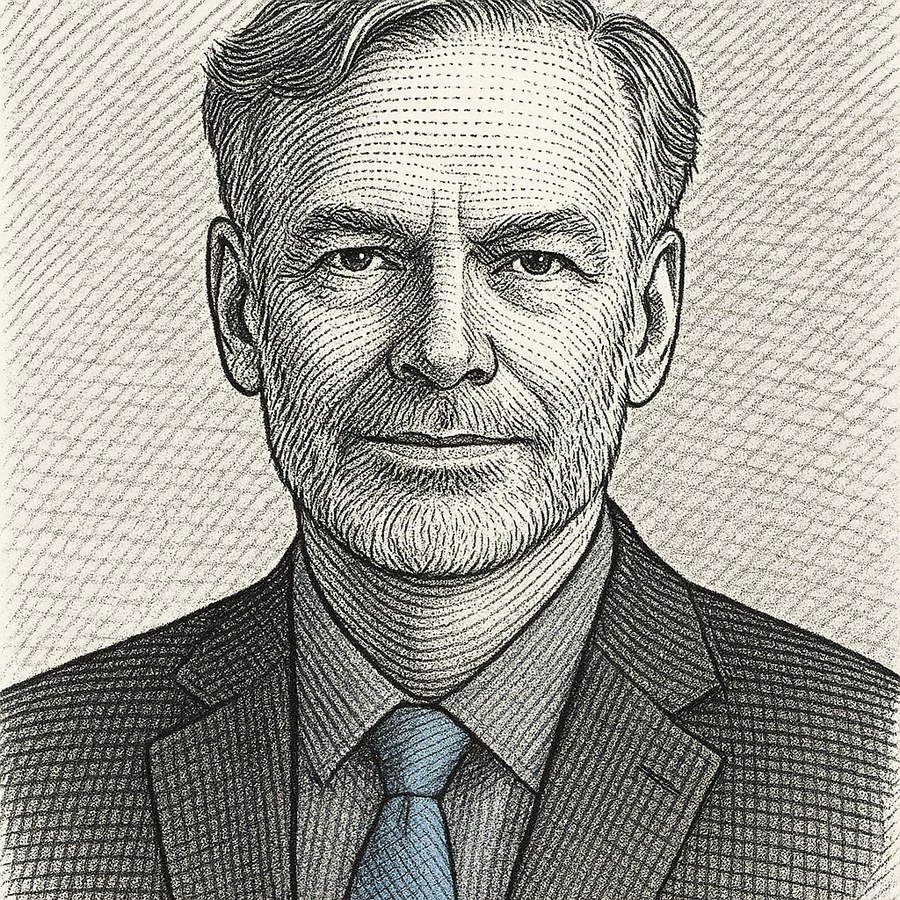
Mark S. Hewitt is co-founder and Chief Technology Officer of Gestalt Capital Dynamics, Chief Technology Officer of PGT Capital, and founder of The Tribernachi Foundation. He is the originator of Tribernachi Theory, a framework in mathematical cosmology anchored by the Genesis Ratio (𝔊₀ = √2 / 12) that bridges quantum structure, sacred geometry, and regenerative systems design.
His career began in frontier Alaska. As a broadcast engineer at KTVF in Fairbanks, he suggested that the proposed Alaska Permanent Fund be made a constitutional amendment rather than a statute. He later served on the Fairbanks City Council and as Chairman of the Fairbanks Utility Board. In the early 1980s he also served as a ceremonial witness and leader at the Tanana Center in Fairbanks, guiding communities through marriages, births, and other life passages.
He went on to work in the early architecture of global satellite communication, on Motorola’s IRIDIUM constellation, and on a national voice-over-internet network at I-Link, and later helped structure Babcock Ranch, a solar-powered new town in Florida — chartered, built, and occupied rather than merely announced.
That throughline — regeneration over extraction, coherence over collapse, systems built to outlast the people who built them — runs across all the books gathered here, now organized into four collections: the MicroCity line’s rigorous argument in The Regenerative Blueprint and The Currency Code, the Indigenous prophecy and Tribernachi Theory woven together in The Remembering, and the working architecture of The Handbook of MicroCities; the physics underneath it all in The Book of Tribernachi; the same ideas carried as story in The MicroCity Chronicles, his first work of fiction; and, in a newer Self-Help collection, the personal and daily-practice side of the same throughline in The Evolution of the Authentic Self. He lives and works between the United States and Canada, where his father’s and his wife’s families are rooted, and is bringing his family back together there. He writes from where the work was first imagined — at the side of his wife Tamar, who has been the constant in a world of variables and unknowns.