
Also published on Medium.
Sometimes an interesting scientific question arrives without warning.
I was sitting behind a gentleman wearing a bright blue NHRA shirt. Across the back, in enormous letters, was NITROMETHANE, followed by the molecular formula:
CH₃NO₂
Most people probably see a racing shirt.
I saw an equation.

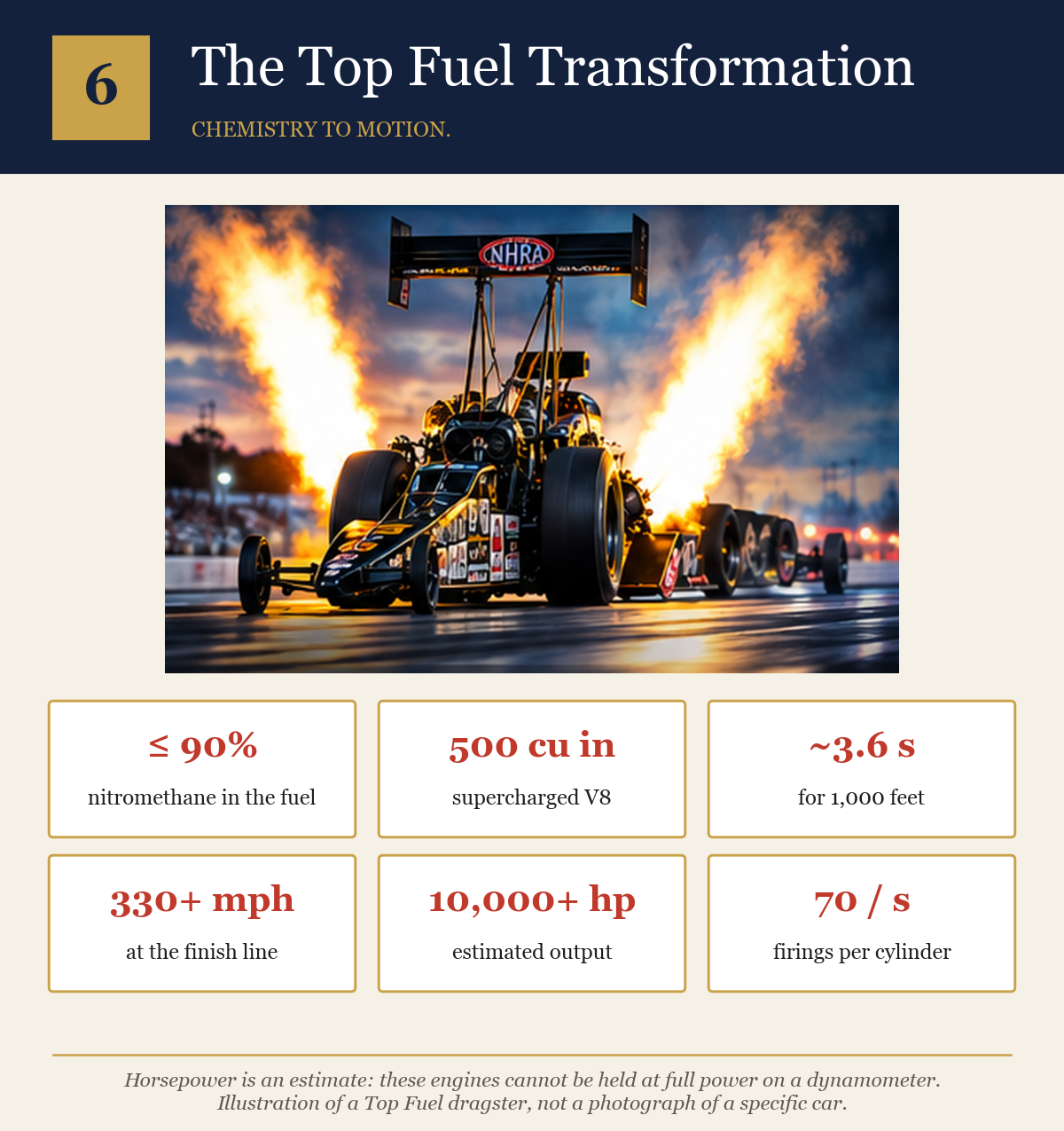
And behind that remarkably simple equation lies an elegant lesson in chemistry, energy, and engineering — one that helps explain how a Top Fuel dragster can produce an estimated 10,000 horsepower or more.
A Very Small Molecule With a Very Big Job
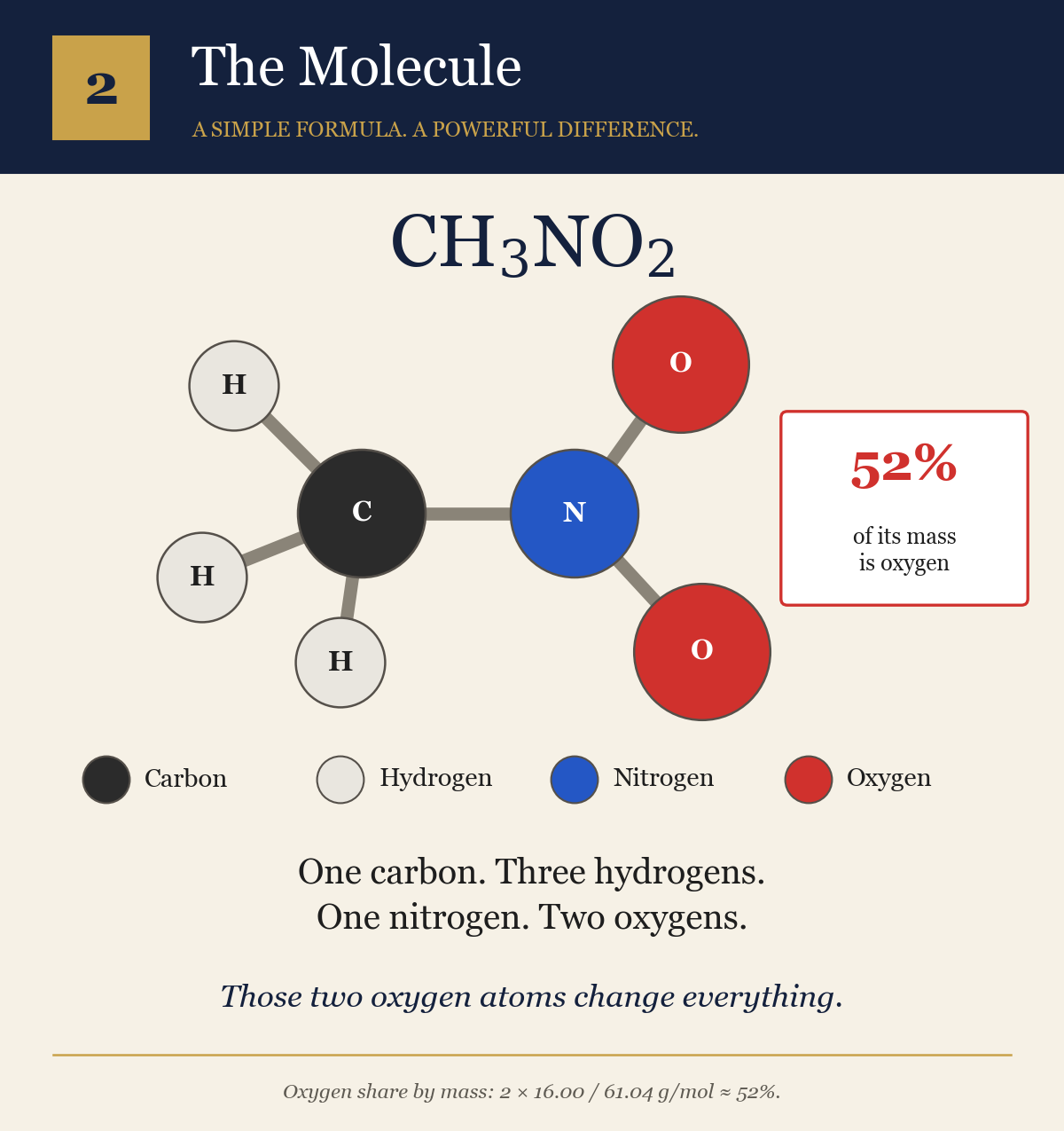
Nitromethane is structurally simple:
CH₃NO₂
One carbon atom. Three hydrogens. One nitrogen. Two oxygens.
But those last two atoms change everything.
Gasoline is primarily a hydrocarbon fuel. To release its stored chemical energy, we must supply oxygen from somewhere else — normally the atmosphere.
In simplified form:
hydrocarbon + O₂ → CO₂ + H₂O + energy
An internal-combustion engine therefore has two related problems. It needs fuel, but it also needs enough air to provide the oxygen required to burn that fuel.
And air is mostly not oxygen. Only about 21% of dry atmospheric air by volume is oxygen.
That means the engine spends an extraordinary amount of its engineering effort simply moving enough atmosphere through itself.
Nitromethane changes the equation.
The Fuel Brings Some of Its Own Oxygen
The two oxygen atoms in CH₃NO₂ are already part of the molecule.
A simplified stoichiometric combustion equation can be written:
4 CH₃NO₂ + 3 O₂ → 4 CO₂ + 6 H₂O + 2 N₂
Look carefully at the left side.
Four molecules of nitromethane require only three additional molecules of oxygen for this idealized reaction.
Compare that with a conventional hydrocarbon, where essentially all of the oxygen needed for complete combustion must be brought into the cylinder from the atmosphere.
This produces one of the wonderfully counterintuitive facts about racing fuel:
Nitromethane does not win because it contains more energy per kilogram than gasoline. It doesn’t.
It wins because an engine can burn enormously more of it with a given quantity of incoming air.
That distinction is fundamental.
Gasoline Has More Energy — Yet Nitro Makes More Power
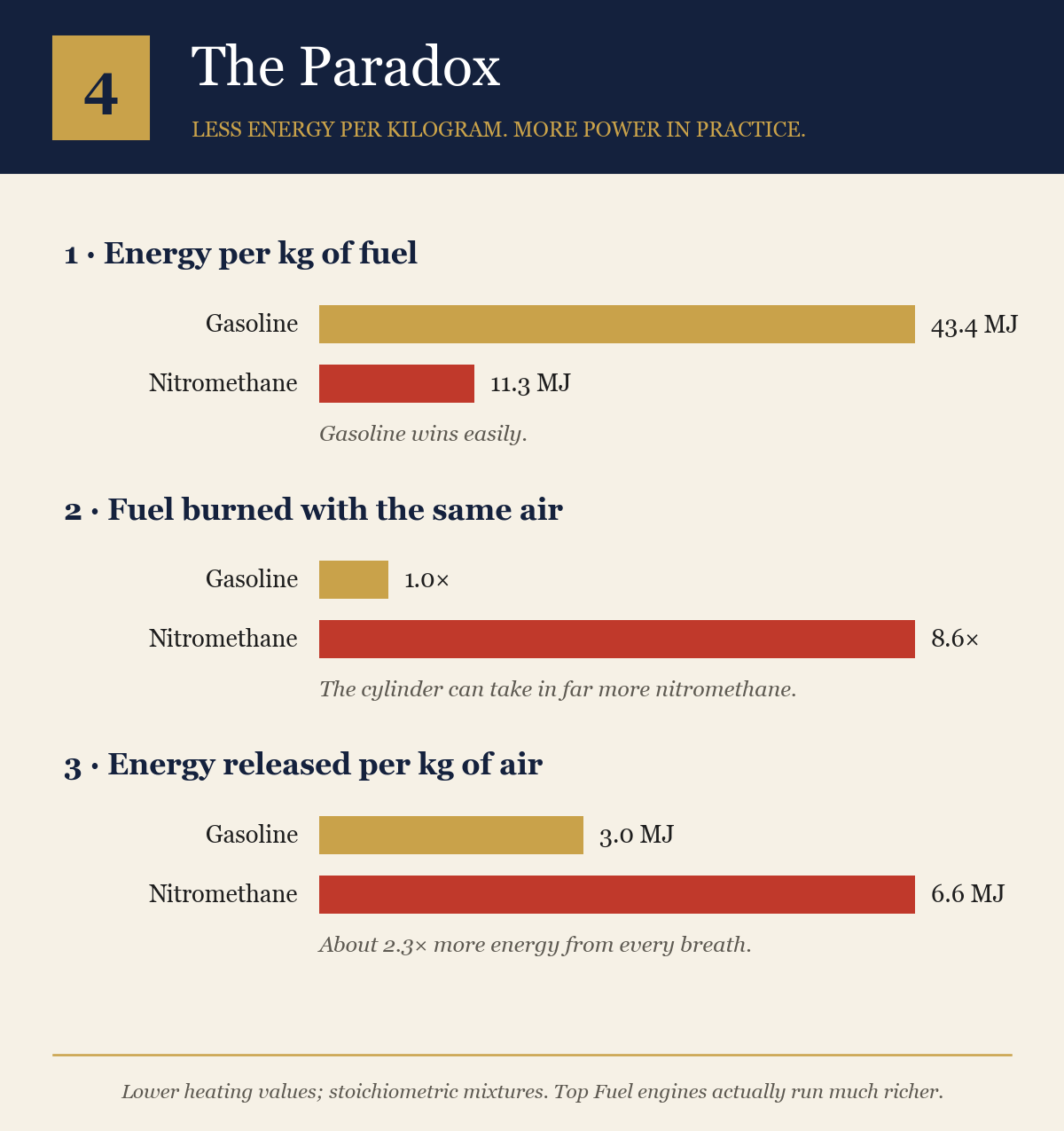
Gasoline has a higher gravimetric heating value than nitromethane. Depending upon the exact gasoline blend and measurement convention, gasoline releases about 43–44 MJ/kg, while nitromethane releases about 11 MJ/kg.
If we simply asked:
Which kilogram of fuel contains more chemical energy?
Gasoline wins easily.
But that isn’t the question a racing engine is trying to answer.
The relevant question is closer to:
How much chemical energy can I release inside this cylinder during this extremely short combustion event?
Now oxygen becomes the constraint.
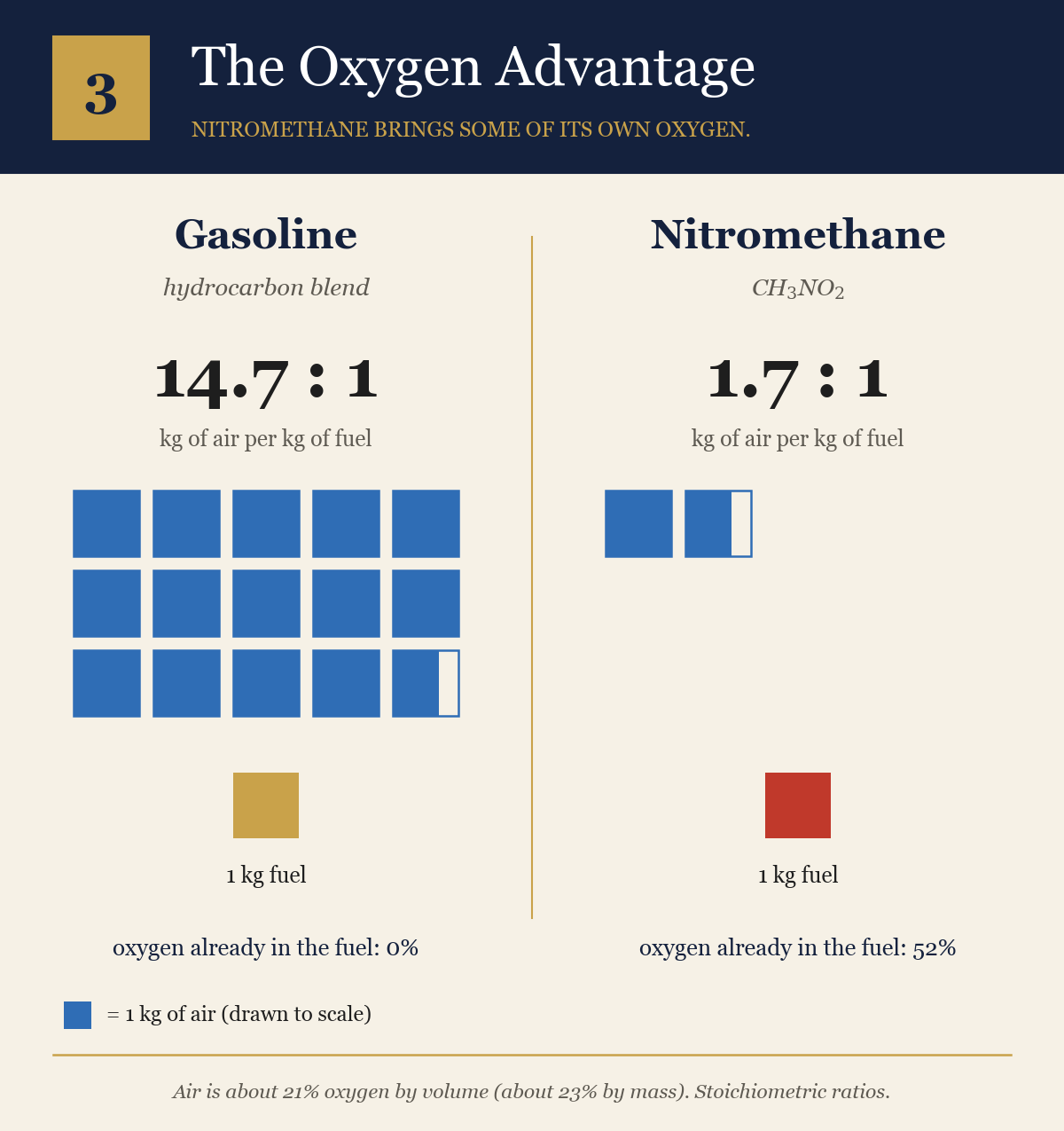
A gasoline engine operating near stoichiometric combustion requires approximately:
14.7 kg of air per kg of fuel
Nitromethane requires only about:
1.7 kg of air per kg of fuel
The precise numbers depend upon fuel composition and operating conditions, but the magnitude of the difference is what matters.
For a given mass of air, an engine can therefore introduce more than eight times as much nitromethane by mass as gasoline.
Suddenly the apparent contradiction disappears.
Nitromethane carries substantially less energy per kilogram, but the cylinder can consume vastly more kilograms of it. Measured per kilogram of air drawn in, the numbers reverse: about 3 MJ for gasoline, about 6.6 MJ for nitromethane. Every breath the engine takes is worth more than twice as much.
And racing engines care about power, not merely fuel energy density.
Energy and Power Are Not the Same Thing
This distinction reaches well beyond drag racing.
Energy tells us how much work can theoretically be obtained.
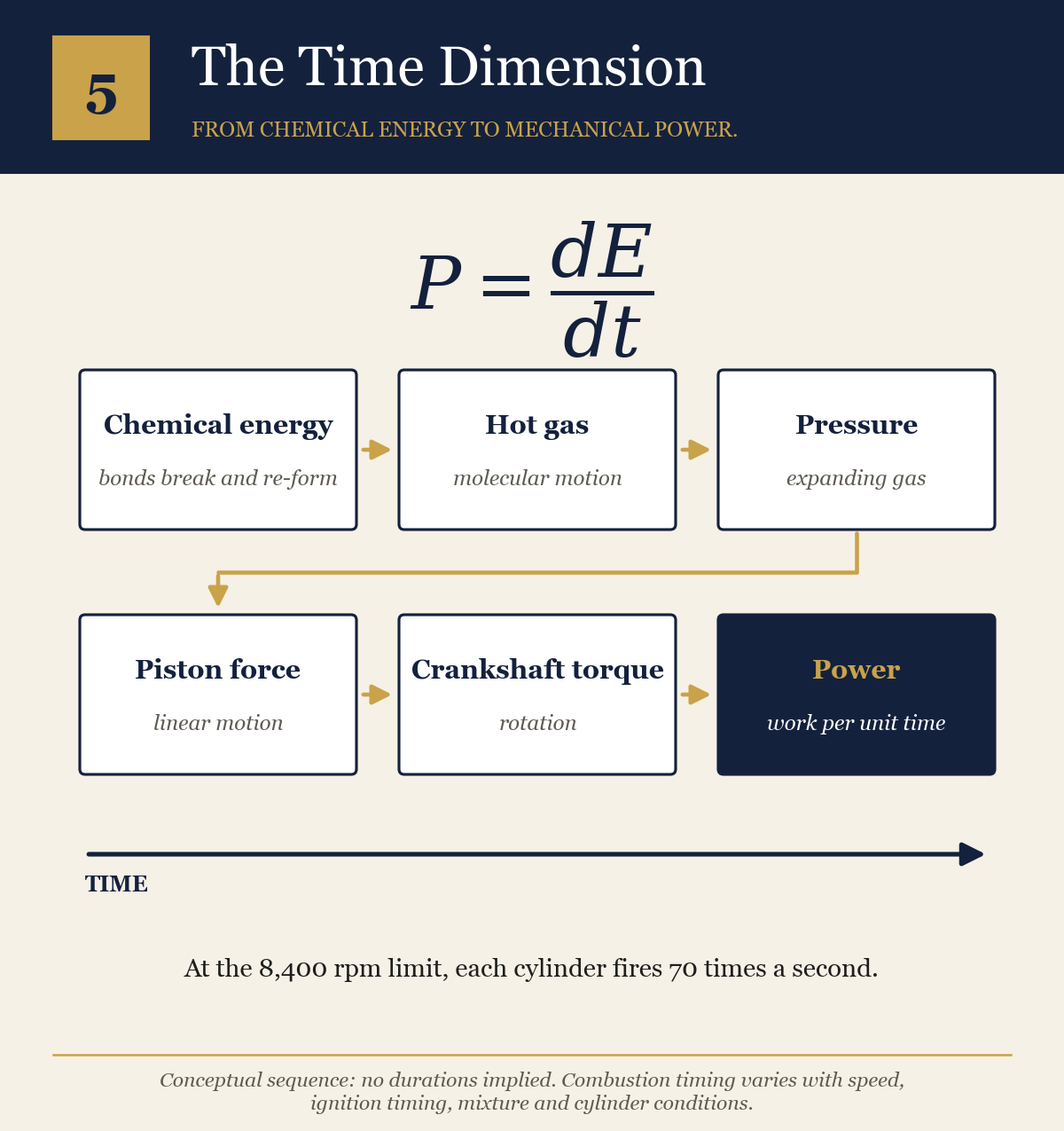
Power tells us how rapidly that energy can be transformed:
P = dE/dt
That denominator — time — changes everything.
A kilogram of material might contain an enormous quantity of potential energy. That does not mean we can release it usefully in a millisecond.
Top Fuel racing is an extraordinary exercise in maximizing the rate of energy transformation.
The engineering problem isn’t simply:
How much energy does the fuel contain?
It becomes:
How much energy can we transform, in this volume, during this interval of time?
That is a very different question.
The Cylinder Is an Energy-Conversion Chamber
Think about what happens inside a Top Fuel cylinder.
Fuel and air enter. The mixture is compressed. Ignition begins. Chemical bonds rearrange. Temperature rises dramatically. Gas expands. Pressure acts upon the piston. The crankshaft converts reciprocating motion into rotation.
All of this happens repeatedly at extraordinary speed.
The cylinder therefore isn’t merely a place where fuel burns.
It is a chemical-to-mechanical energy transformation chamber constrained by geometry, pressure, temperature, reaction kinetics, material strength and time.
From this perspective, horsepower becomes the macroscopic measurement of an extraordinarily complicated microscopic process.
Chemical potential becomes molecular motion.
Molecular motion becomes pressure.
Pressure becomes piston force.
Piston force becomes torque.
Torque delivered through time becomes power.
And eventually that power becomes a vehicle covering 1,000 feet of drag strip in well under four seconds.
Why the Exhaust Looks Almost Violent
Anyone who has watched a Top Fuel dragster — especially at night — has seen the enormous flames emerging from the exhaust headers.
Those flames are another clue that we are nowhere near the tidy chemistry of a classroom equation.
A racing engine is not operated simply to produce perfect stoichiometric combustion. Top Fuel engines run extraordinarily rich mixtures under extreme cylinder pressures and temperatures. Combustion products can include incompletely reacted species, and reactions can continue into the exhaust stream.
The beautiful equation:
4 CH₃NO₂ + 3 O₂ → 4 CO₂ + 6 H₂O + 2 N₂
is therefore a useful bookkeeping model — not a complete description of what is occurring inside a racing cylinder.
Reality includes reaction kinetics, intermediate species, heat transfer, dissociation, changing pressure, turbulent mixing and combustion occurring on astonishingly short timescales.
The chemistry is dynamic.
There Is a Larger Lesson Here
What caught my attention about that shirt wasn’t ultimately nitromethane.
It was the reminder that we frequently misunderstand energy systems because we focus on the wrong variable.
We ask:
How much energy does it contain?
When perhaps we should also ask:
How rapidly can that energy be transformed?
What limits the transformation?
What must be transported into the system?
What products must be transported out?
What geometry contains the reaction?
What happens when time becomes the dominant constraint?
Nitromethane demonstrates beautifully that optimizing one variable — energy density — does not necessarily optimize the system.
Sometimes the breakthrough comes from changing the constraint.
In this case, the constraint is oxygen.
Instead of asking the engine to inhale enough atmosphere to support vastly more combustion, chemistry puts part of the required oxygen inside the fuel molecule itself.
That changes the architecture of the problem.
From a T-Shirt to Thermodynamics
There is something I particularly enjoy about science: profound ideas are hiding everywhere.
A leaf contains quantum mechanics.
A glass of ice water contains thermodynamics.
A rainbow contains electromagnetic spectroscopy.
And apparently, a gentleman’s NHRA T-shirt in a restaurant contains a lesson about molecular chemistry, combustion kinetics, energy density, power density and engineering optimization.
The formula printed across his back was only six characters:
CH₃NO₂
But embedded within those six characters is an important engineering principle:
The performance of an energy system is determined not simply by how much energy it contains, but by how much energy the system can transform within the available space and time.
And that is why a molecule with less energy per kilogram can help produce one of the most powerful piston engines ever built.
Sometimes, changing the fuel changes more than the fuel.
It changes the equation.