Also published on Medium.
This week Ethan Siegel published an excellent piece in his Starts With A Bang series: The Higgs boson’s most important puzzle remains unsolved.
His argument goes like this. Finding the Higgs boson in 2012 completed the Standard Model. It did not tell us how the Higgs field settled into its present state as the young Universe cooled. Did it roll smoothly downhill everywhere at once? Or did it get stuck in a false valley first, and then break free in bubbles, patch by patch?
That distinction sounds technical. It isn’t a small one. If the change happened in bubbles (a first-order transition), the Universe would have been thrown out of balance at exactly the moment when the excess of matter over antimatter could have been created. If it was smooth, the Standard Model falls short of explaining that excess by a factor of about ten billion.
In other words, the reason there is something rather than nothing may come down to the texture of a phase transition that ended a trillionth of a second after the Big Bang.
I agree with Ethan about the question. I want to offer a different way of looking at it, one I’ve been developing for many years.
The assumption underneath the hill
Every picture in Ethan’s article, the ball rolling down a hill and the ball trapped in a dip, draws the vacuum as a smooth landscape. The equations behind those pictures make the same assumption: space is a continuum. You can divide any distance in half, and in half again, forever.
That has been a spectacularly useful assumption. It is still an assumption.
Suppose instead that space is granular: built from tiny cells the way a crystal is built from atoms. Then a new question appears that the smooth picture can’t even ask:
Can the cells fit together perfectly?
If they can, the vacuum can cool the way water becomes ice on a calm pond: evenly, everywhere at once. If they can’t, the vacuum has to compromise as it cools. Compromise is where things get interesting.
The Tribron
The simplest solid there is is the tetrahedron: four triangular faces, four corners, six edges. It is the 3D shape with the fewest possible faces, and it is perfectly balanced: from its center, all four corners sit in exactly the same relation to one another. A cube can’t say that.
In the framework I call Tribernachi, this solid is the basic unit of space, and I call it the Tribron. Its volume, for a tetrahedron with edges of length one, is
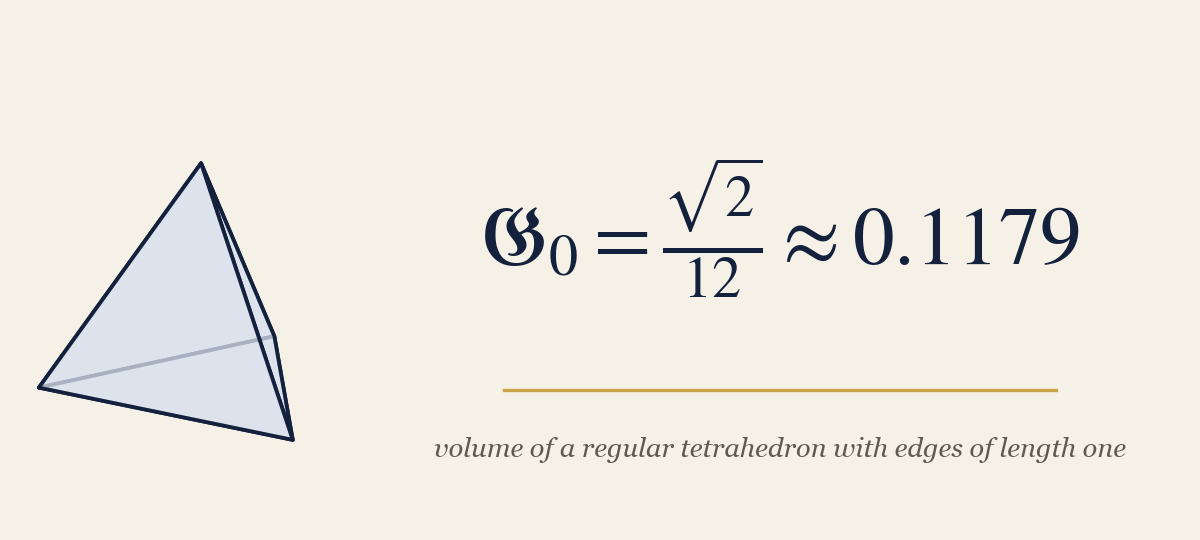
That single number turned out to be the key that opened much of the framework. But for this article, what matters is a much older fact about the tetrahedron, one that tripped up Aristotle.
The shape that can’t fill flat space
Aristotle claimed that identical regular tetrahedra could fill space with no gaps, the way cubes do. He was wrong, and the error stood for well over a thousand years before mathematicians corrected it.
Here is why. Stack tetrahedra face to face around one shared edge. The angle between two faces of a tetrahedron is about 70.53°. Five of them come to 352.64°, which is just short of a full turn. Six would overshoot.
So five tetrahedra around an edge always leave a sliver of empty space: a gap of 7.36°.
It’s easier to see one dimension down. Put five equilateral triangles around a point on a flat table and you get a 60° gap. Now fold them up until the edges meet. The gap closes, and the triangles form a little cap. Keep going and you get an icosahedron, a solid that is almost a sphere.
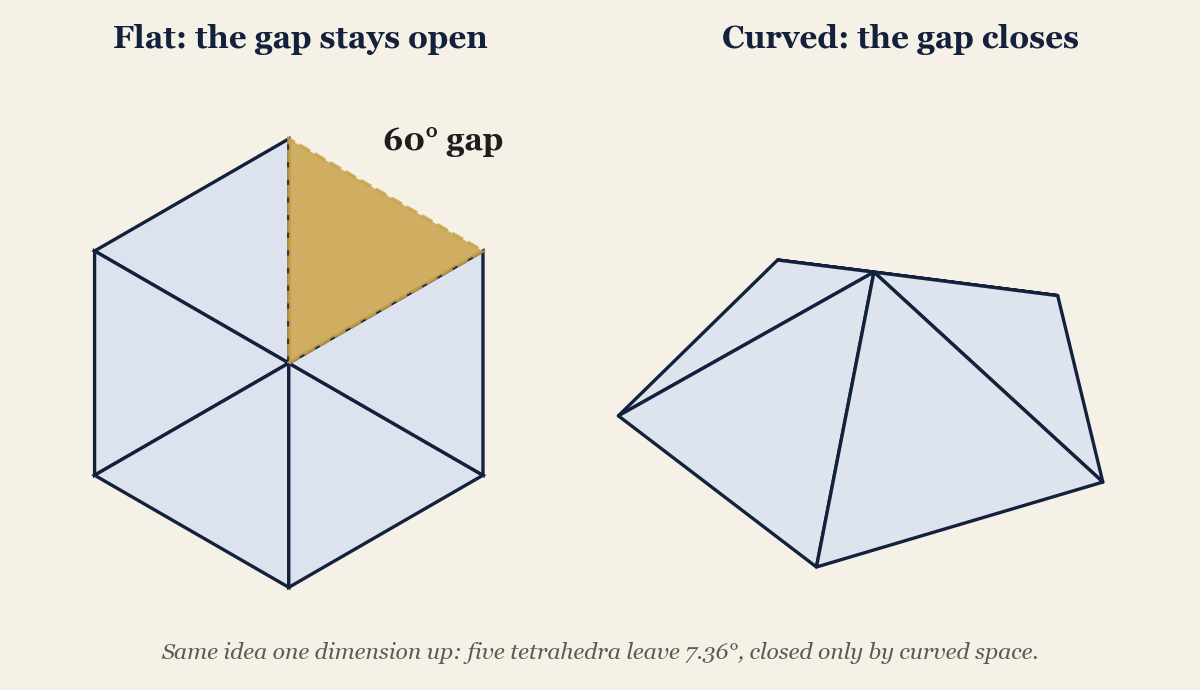
The same thing happens with tetrahedra, one dimension up. In flat 3D space, the 7.36° gap can’t be closed. In a curved three-dimensional space, it can. Mathematicians have known for more than a century that exactly 600 regular tetrahedra, five around every edge, fit together with no gaps at all to close up a perfectly curved space (the “600-cell”).
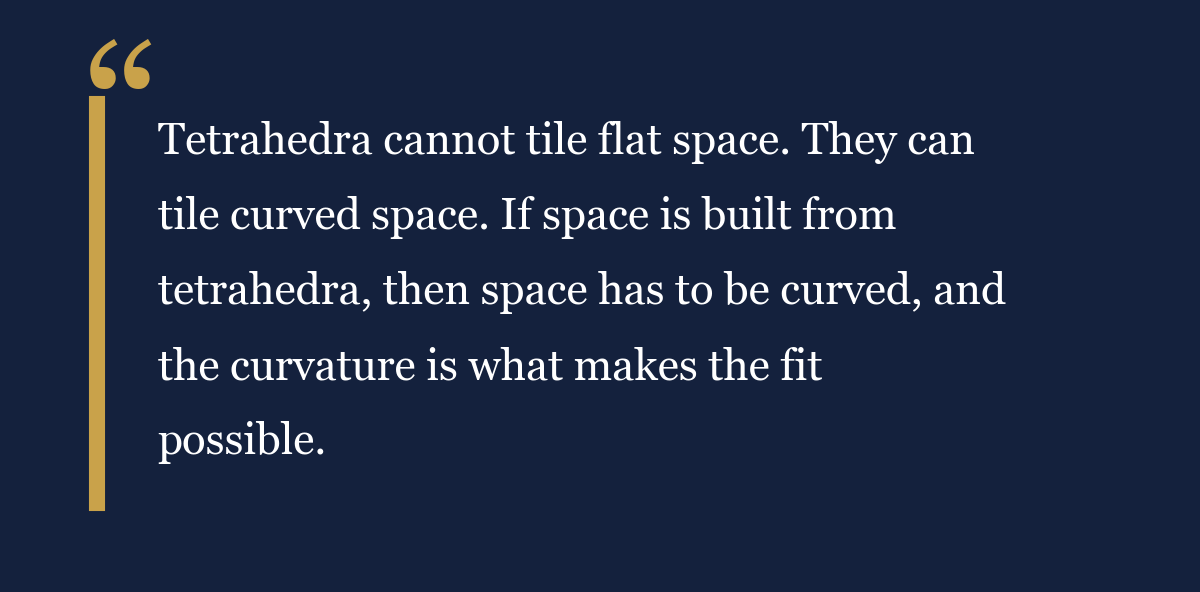
That is the core idea, and I want to state it plainly:
Flat inside, curved at the seams
This isn’t a fringe idea in its geometry. In 1961 the physicist Tullio Regge showed that Einstein’s curved spacetime can be built from flat pieces glued together. Each piece is perfectly flat inside. All the curvature lives on the shared edges, as exactly this kind of missing angle. Modern approaches to quantum gravity, such as Causal Dynamical Triangulations, still build spacetime this way.
This gives a simple picture. Stand at the center of a Tribron and space looks straight. Step outside it, across a seam, and you see curvature. Gravity in this picture is not a force pulling on things. It is the geometry of how the cells meet, which is Einstein’s own view of gravity, made granular.
It also reconciles two things that sound contradictory. Astronomers measure the Universe to be very nearly flat on the largest scales. A tetrahedral Universe can be flat on average and curved everywhere, like a sheet of hammered copper: flat from across the room, and dimpled under the hand.
Why a frustrated vacuum can’t cool smoothly
Now back to Ethan’s puzzle.
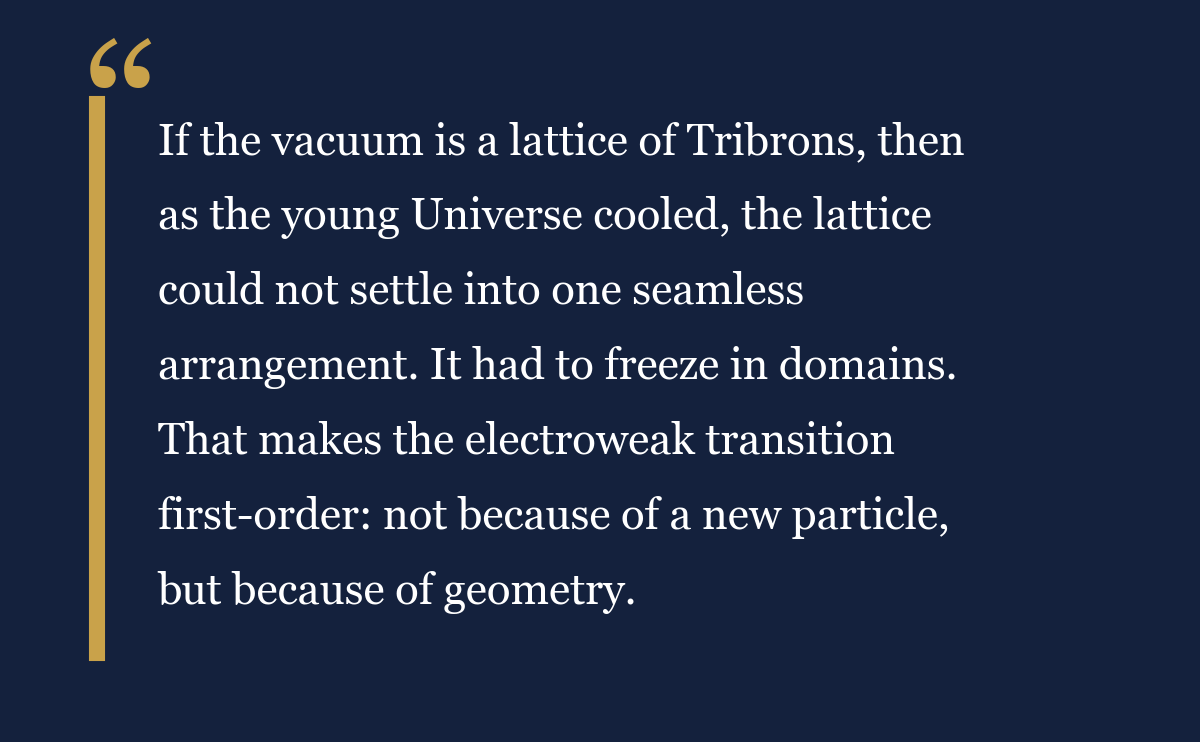
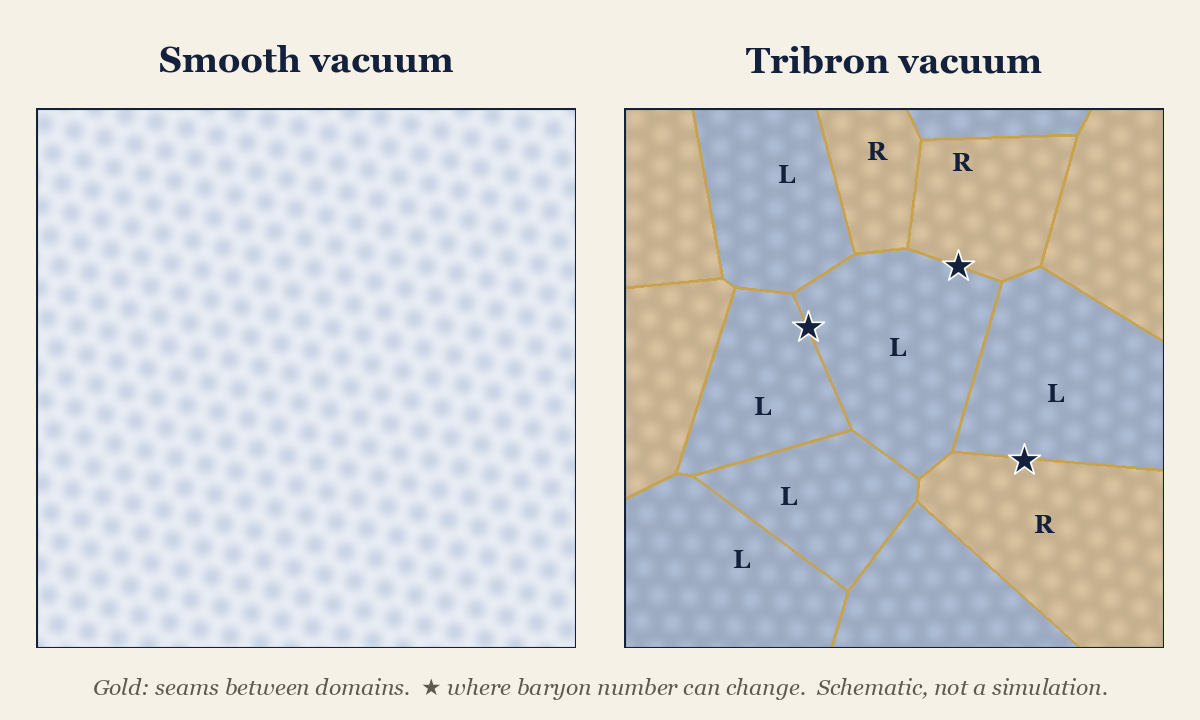
There is a well-known case in ordinary physics where a material “wants” to settle into tetrahedral order and can’t extend it. In 1952 Charles Frank explained why liquid metals can be cooled far below their freezing point without freezing. The atoms find that clusters built from tetrahedra are the most comfortable local arrangement. But those clusters can’t tile space, for the same 7.36° reason. So the liquid gets stuck: locally happy, globally frustrated. When it finally does freeze, it does so abruptly, in grains and domains with seams between them.
Physicists call this geometric frustration, and it is a recipe for exactly the kind of transition Ethan is looking for: a false minimum, then sudden, patchy release.
In current Standard Model calculations, the electroweak transition is not even second-order. For a Higgs boson of 125 GeV, computer simulations show it is a smooth crossover. Those simulations put the Standard Model’s fields on an artificial grid and then take the grid away. Nothing in the theory itself says the vacuum’s underlying cells can’t fit together.
So here is the hypothesis:
It’s worth noticing that the Standard Model already concedes the deeper point behind this. The Higgs field’s lowest-energy state is not zero. Its value in empty space is about 246 GeV everywhere. Empty space, in the Standard Model, is already something: a floor, not a void. A Tribron lattice is one way to say what that something is made of.
A twist that has to choose
The second Sakharov condition is a preference: nature has to treat matter and its mirror image differently (C and CP violation). Here the tetrahedron has one more surprise.
Stack tetrahedra face to face in a line, each one on a face of the last, and they don’t form a straight column. They form a twisted rod, called the tetrahelix (or Boerdijk–Coxeter helix). It has to twist, and it can twist only one of two ways: left-handed or right-handed. Each new tetrahedron turns about 131.8° around the axis, an angle that never brings the pattern back into exact alignment.
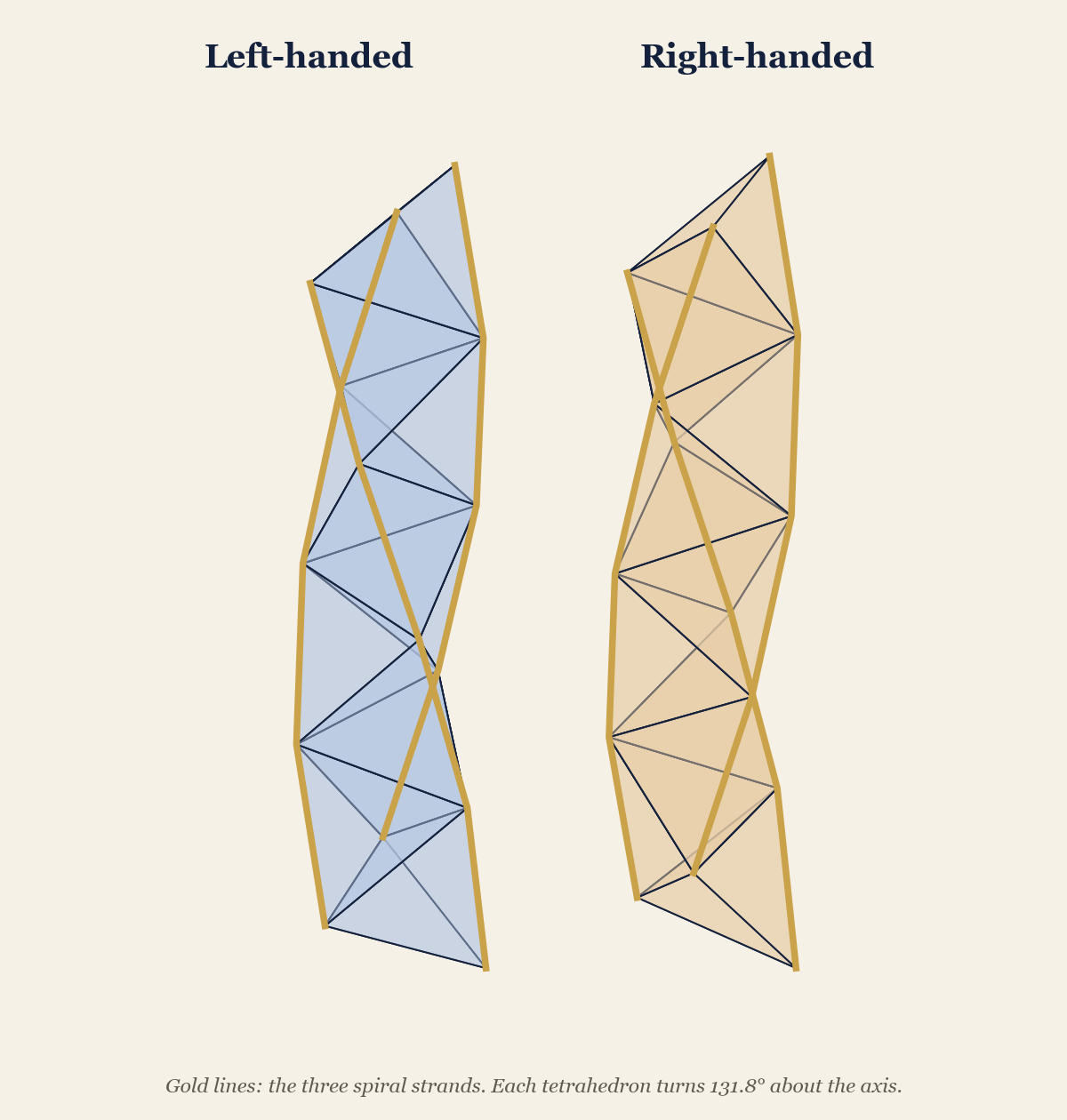
Handedness is built into the geometry. A lattice of tetrahedra that has to freeze in domains also has to decide, domain by domain, which way to twist. And the weak force, the one at the center of Ethan’s article, is famously left-handed: it acts only on left-handed matter particles.
Put the pieces side by side:
- Out of equilibrium: a frustrated lattice can’t cool smoothly; it freezes in domains. – A handed preference: tetrahedral structures must twist one way or the other. – Breaking baryon number: the Standard Model’s own sphaleron processes, already known to work at this temperature, operate at and around the seams between domains, where the Higgs field changes from place to place.
Those are Sakharov’s three conditions. I am not claiming this calculation is done. I’m claiming that a granular, tetrahedral vacuum supplies the first two ingredients from its geometry, where the smooth picture has to add new particles to get them.
Could the neutrino be made of tetrahedra?
If space is built from Tribrons, then particles are patterns in that lattice, not things sitting on top of it. The neutrino is the place I’d look first. Look at what we know about it:
- It is the lightest known particle with mass, far lighter than the electron, but not massless. – Every neutrino ever observed is left-handed (and every antineutrino right-handed). – It comes in three types, and it changes from one type to another as it travels.
A short length of tetrahelix has all three of those features in its shape. It is handed by construction. Its outer edges form three intertwined spiral strands. And because its twist never quite repeats, it never quite closes on itself. That near-miss is the same kind of small leftover as the 7.36° gap. In a lattice picture, a small leftover is exactly what a very small mass would look like.
The mathematics of Tribernachi points the same way. Its core recurrence, the “tribonacci” rule where each term is the sum of the three before it, has three roots: one steady, and two that rotate around each other. Three states, two of them circling, is a reasonable cartoon of three neutrino types trading places.
I want to be careful here. This is a picture, not a derivation. When we tested the simplest direct match between a Tribernachi constant and the measured neutrino mass ratios, it failed: last year’s precise measurements from the JUNO experiment rule it out. We recorded that result and wrote down our next predictions before comparing them with the data, so we can’t fool ourselves by trying number after number until one fits.
How we’ll find out
The ideas in this essay can be tested.
- Gravitational waves. A first-order transition in the early Universe would leave a background hum of gravitational waves at a specific range of frequencies. The LISA space observatory, planned for the 2030s, is designed to hear it. A smooth crossover leaves no such signal. – The Higgs boson’s self-interaction. How strongly the Higgs interacts with itself sets the shape of the “hill.” The High-Luminosity LHC and a future collider will measure it. A first-order transition needs it to differ from the Standard Model value. – Neutrinoless double-beta decay. If the neutrino is its own antiparticle, which is the version of this picture we have written down as a prediction, certain nuclei can undergo a rare decay that emits no neutrinos at all. Experiments such as LEGEND and nEXO are searching for it now. – The graininess of space itself. Any granular picture has to explain why we don’t see the grain. Light from distant gamma-ray bursts arrives with no detectable smearing across colors, even after crossing billions of light-years. A Tribron lattice has to pass that test as Regge’s geometry does: smooth on average, granular only at the finest scale.
The texture of the hill
Ethan closes by saying that, with one of the greatest open questions in physics possibly within reach, we owe it to ourselves to investigate. I agree.
I’d add one suggestion for how to look. We have spent fifty years asking what shape the hill was: smooth slope, or dip on the way down. It may be worth asking what the hill is made of.
If space is built from the simplest solid there is, a solid that cannot fit perfectly with copies of itself unless space curves, then the young Universe could never have cooled smoothly. It had to freeze in pieces, each choosing a twist, with seams in between.
And in those seams, some matter may have been left over.
That leftover is us.